

The 1964 Lincoln cent is common, with large surviving quantities from both Philadelphia and Denver. Because of this, the 1964 penny value depends not on the date, but on the condition of the surface. Collectors evaluate these coins by how much of the original mint red color remains. This is why the standard color categories — Red (RD), Red-Brown (RB), and Brown (BN) — play a direct role in pricing.
Color reflects preservation. A coin that still shows its original red tone has usually been stored carefully since minting. A deeper brown surface indicates natural aging or past handling. The difference in color often leads to a clear difference in value, even when the grade and mint mark are the same.
Why Color Matters in Copper Coins
Copper is reactive. As soon as a coin leaves the press, the surface begins to interact with oxygen and moisture. This reaction continues slowly over time. The bright, new copper color shifts into deeper tones. The change is natural. It cannot be fully stopped, only slowed.
Points to understand:
Copper darkens over time. The change is gradual, from bright orange-red to deep brown.
Original red survives rarely. A coin must be stored carefully and handled minimally to keep RD.
Red-Brown is transitional. It shows partial preservation and partial natural toning.
Brown is the common endpoint. It does not mean damage. It reflects age and oxygen exposure.
Color is not just appearance - it shows preservation. A Red coin signals long-term careful storage. A Brown coin has seen more air exposure or handling.
Practical storage tip: Keep copper coins in inert holders and avoid PVC plastics. Stable temperature and low humidity preserve surface tone.
Understanding RD, RB, and BN
Below is the standard classification used by collectors and grading companies:
Color Class | Description | Availability | General Price Behavior |
RD (Red) | Bright mint copper color, minimal darkening | Rare among older coins | Highest prices |
RB (Red-Brown) | Mix of red and brown tones, gradual transitions | Moderately available | Mid-range pricing |
BN (Brown) | Fully toned copper surface, uniform brown color | Most common | Lowest pricing |
Key principle: The closer the surface remains to the original RD, the stronger the market response.
RD coins look alive. They reflect light smoothly and evenly. RB coins show partial brightness, often in protected areas. BN coins look stable but lack the visual energy of earlier stages.
Color alone does not define value. It works together with condition and luster. However, color is the part collectors notice first. It sets expectations before grade details are considered.

1964 Penny Market Reality
The 1964 cent has no rarity based on mintage. The rarity is in fine preservation. Most coins were in use or stored loosely, handled, or exposed to air. That means most surviving pieces are BN or RB. True RD examples with stable surface color are limited.
A grading number (MS63, MS64, MS65) is not enough to determine value alone. Two coins with the same grade can look entirely different. A coin with real RD and smooth, even fields will attract strong interest. A coin with the same grade but weak color or dull surfaces will not.
Here is a realistic price guide for typical market behavior:
Price Comparison by Grade and Color
Surface / Grade | Typical Price Range |
BN (XF–AU) | $0.05–$3 |
RB (AU–MS63) | $2–$20 |
RD (MS64–MS65) | $10–$120 |
RD (MS66+) | $150–$450+ (uncommon) |
Proof 1964 RD | $30–$300+ (depending on field clarity and luster quality) |
Value appears only when both surface state and color are strong. A lower grade RD is often more desirable than a higher grade RB or BN. Collectors respond to what the coin actually looks like in hand.
How to Evaluate Color and Surface Quality
A structured visual approach helps separate natural surfaces from altered ones.
Lighting
Use soft, indirect lighting rather than a bright overhead or direct LED source. Hard light creates glare and can hide texture by flattening contrast on the fields.
Indirect light shows how the surface reflects across high and low areas and makes any irregularities more visible. A lamp with a diffused shade or sunlight filtered through a curtain is ideal.
Rotation
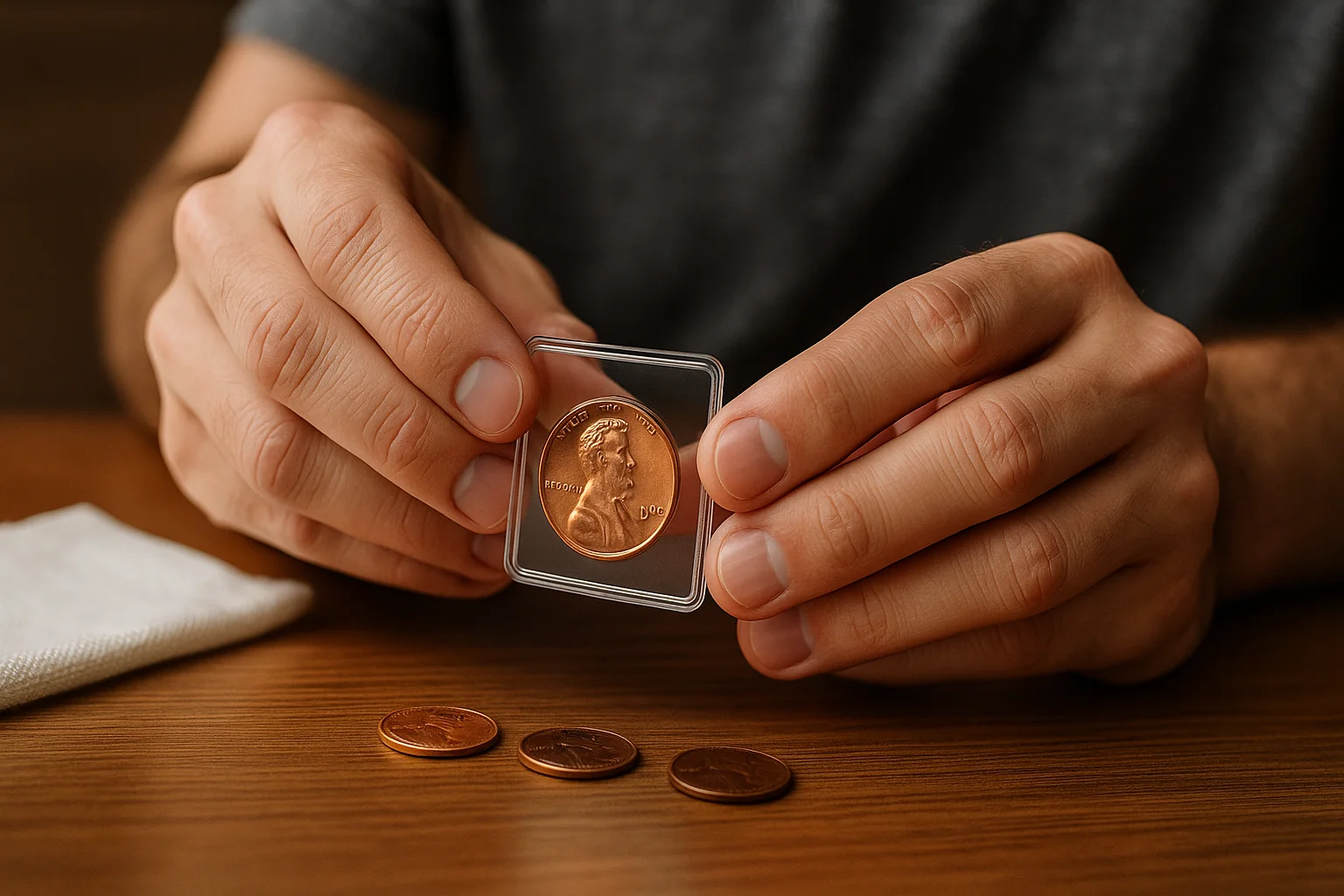
Hold the coin at a slight angle and rotate it slowly. Watch how the light moves across the fields. A genuine RD surface shows a smooth cartwheel effect with continuous motion.
If the luster stops, breaks, or looks static, the surface may have been disturbed or is dull from age or handling. This step is useful even without magnification.
Comparison
Place three or four 1964 cents side by side on the same surface. Differences in color tone and texture become easier to see when you compare coins directly.
RB and BN shades show gradual transitions, while unnatural surfaces stand out by their uneven patches or inconsistent shine. Comparison helps train the eye quickly.
Surface Texture
Under magnification or close inspection, original copper shows a fine, even grain with no sharp streaks. Cleaned or recolored coins often display faint parallel lines, blotchy shine, or a flat, featureless surface. The difference is especially noticeable in the fields between the portrait and inscriptions.
If the coin’s red appears overly bright, reflective, or glass-like instead of warm and metallic, the surface may have been artificially brightened. This is common with recoloring agents or abrasive cleaning. These coins may look “new” at a glance but lose collector value because the natural surface has been altered.
Quick Visual Checklist
Feature | Strong Sign | Weak / Problem Sign |
Color Tone | Even and stable | Patchy or artificial brightness |
Luster | Smooth movement when rotated | Dull or uneven reflection |
Surface Texture | Natural fine grain | Thin parallel hairlines (cleaning marks) |
Strike Details | Sharp letters and portrait | Soft shapes not caused by natural wear |
This checklist functions as a fast filter when reviewing multiple coins. A coin showing strong signs across several categories typically indicates stable, original preservation. The fewer strong signs present, the closer the coin may be to average condition or altered surfaces. Over time, the eye becomes faster at recognizing these patterns.
FAQ
Is a 1964 penny rare?
No. Most 1964 cents are common. Rarity exists mainly in high-grade examples that still show a strong RD surface.
What makes a 1964 penny valuable?
Original mint color, stable luster, clear texture, and no evidence of cleaning. These features indicate careful long-term storage.
Should 1964 cents be graded?
Generally only MS65 RD or higher quality is worth grading. RB and BN examples should be evaluated individually because value varies more widely.
Are proof 1964 pennies more valuable?
Yes, when the mirrors are clean and surfaces are free from haze, cloudiness, or spotting. Disturbances in proof fields reduce value quickly.
Color Preserves Value
Color is the record of how a coin has been stored and handled. The 1964 cent shows this clearly. Most are brown, some are red-brown, and few only remain red. The market follows this pattern directly. Coins that held their original tone, texture, and luster show care and preservation. Those coins draw the strongest bids.
Collectors often document surfaces over time to track color changes. A simple way to do this is to store images and notes. Try the Coin ID Scanner app to photograph coins, record surface tone, and compare RD, RB, and BN examples side-by-side. This helps avoid mistakes and evaluate pieces correctly. And remember: attention to color is attention to history. A steady eye will help you to build a strong collection.